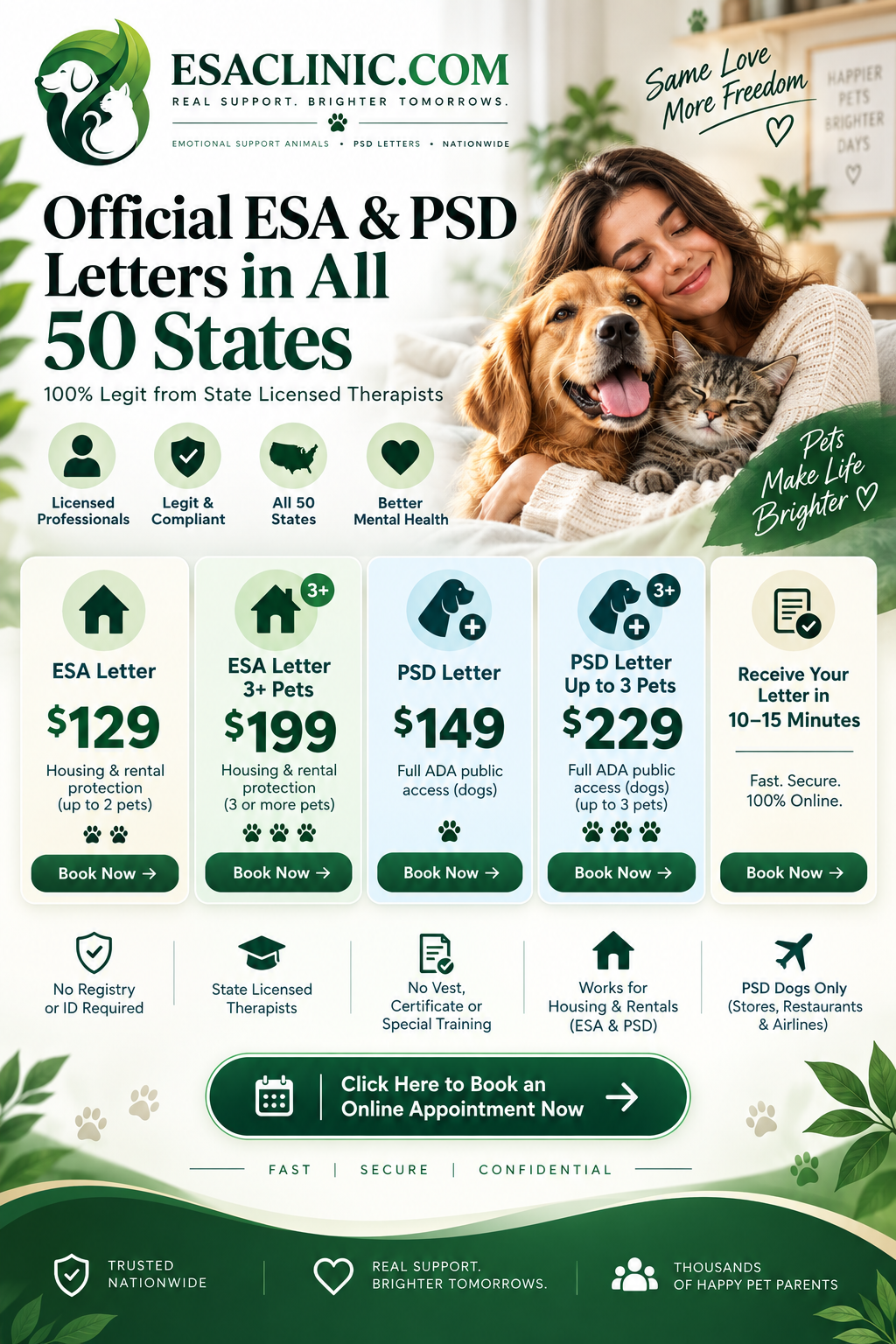

If your pet does more than simply provide companionship – if they get you through your panic attacks, reduce your depression, or help you feel at ease at home – then you could be eligible for an Emotional Support Animal (ESA) letter. This single document would allow you to keep your animal in a “no pets” living environment, provided it is done the right way.
The amount of misinformation that circulates on the Internet will make this process look like something more complicated or more magical than it should be. That’s why we’re going to tell you all about what an ESA letter actually is, whose role it is to write such a letter, and how to get yours from a licensed mental health professional (LMHP).
What Is an ESA Letter, Exactly?
An ESA letter is a formal, written, and signed letter from a mental health professional licensed in your state, and which attests that you have been diagnosed with an emotional or mental disorder and that living with an animal is a part of your treatment. The letter is neither a certification nor an identification card because these documents can be bought on unregulated web pages and will not carry any legal significance.
What counts legally is your letter, and nothing else but the letter itself.
Who Is Considered a “Licensed Mental Health Professional”?
This is the part people get wrong most often. Anybody, even if they are doctors, life coaches, or online quizzes, cannot provide you with an authentic ESA letter. The individual issuing your ESA letter must have an active license and should be:
- Licensed Clinical Psychologist (PhD/PsyD)
- Licensed Clinical Social Worker (LCSW)
- Licensed Professional Counselor (LPC)/Licensed Mental Health Counselor (LMHC)
- Licensed Marriage and Family Therapist (LMFT)
- Psychiatrist/Psychiatric Nurse Practitioner
- Licensed Physician, having evaluated your mental health diagnosis
Landlords are becoming more familiar with scams involving letter mills, and it is not unusual for them to check the license number of the issuer of the letter before accepting it. An ESA letter from somebody who doesn’t hold an active license is virtually useless.
Do You Actually Qualify for an ESA?
For the person to be eligible for this program, they must have an emotional or mental disability that can be positively influenced by the presence of their animal companion. It is not limited to one particular disorder, since it usually includes:
- Anxiety disorders
- Depression
- PTSD
- Panic disorder
- Social anxiety or phobias
- Chronic stress-related conditions
- ADHD-related emotional dysregulation
Simply being stressed or “loving your pet” does not count as an adequate reason. In order for a qualified LMHP to issue an ESA letter for the client, the client’s disability must qualify as a true impairment.
Step-by-Step: How to Get Your ESA Letter
1. Choose a Legitimate, Licensed Provider
Avoid any that guarantee a letter with the phrase “no evaluation needed,” or a letter based on a five-question quiz – this is precisely what landlords are taught to refuse. Seek out a provider who will connect you to an actual state-licensed clinician, preferably via a proper telehealth appointment.
That’s what makes ESA Clinic unique. ESA Clinic helps connect you to actual state-licensed mental health clinicians for a proper evaluation, rather than one of those stamp-of-approval forms. It is this difference that is critical when your landlord, homeowners’ association, or airline ever challenges your letter.
2. Complete a Pre-Screening Questionnaire
A legitimate process usually starts off with a brief questionnaire regarding your symptoms, struggles, and how your pet helps you deal with them. This is not the letter; this is just to help identify if an evaluation is needed for you.
3. Have a Real Consultation With a Licensed Clinician
The one thing you cannot skip in any way is consulting with a licensed professional. Before issuing an ESA letter, a licensed professional should examine you – by phone, online, or in person. They will ask you about your symptoms, history, and how the animal helps you with your psychological issues. Some states now demand a pre-existing relationship between the client and a clinician (such as in California, where the rule AB 468 applies).
4. Receive Your Signed ESA Letter
In the event that the physician finds that you are eligible for such an accommodation, he or she will send out an official letter. Reputable companies like ESA Clinic usually do this within one or two days of your examination once the clinical need has been fulfilled.
5. Keep It Current
The letter of your ESA cannot be a permanent one. You should always renew it on an annual basis, especially before moving houses or taking up a new lease.
What a Valid ESA Letter Must Include
The following are the basic components of a valid ESA letter:
- Clinician’s letterhead, name, license, and license number
- Clinician’s contact details for verifying the letter
- Your name
- A statement that proves you have a qualifying disability and require an ESA
- The clinician’s signature and the date when the letter is issued
Failure to include these elements gives the landlord a reason to doubt the letter’s validity.
Your Rights Under the Fair Housing Act
Once you receive an ESA letter, the Fair Housing Act demands landlords make reasonable modifications for your emotional support animal, even when they have strict no-pet policies. In particular,
- Landlords are not supposed to charge any pet fees, pet deposits, or pet rent for your ESA
- They should not impose any breed or weight limits on your animal
- The animal will not count toward the total number of pets that are allowed in the building
There are very specific reasons why the landlord can deny your ESA request; these include direct threat from the animal, previous property damage from your animal, or unreasonable cost associated with accommodating your needs
It is important to note that in May 2026, the HUD issued an internal guideline about how strictly they will investigate certain ESA requests, but the act remains unchanged, and a verified letter from a licensed professional mental health care provider continues to give you the right of accommodation under the law.
ESA vs. Service Animal: Know the Difference
There is a difference between ESAs and service animals since ESAs do not require any particular training to work, while service animals are trained to perform particular tasks and are protected as part of the ADA when it comes to public settings. It is crucial to understand that emotional support animals cannot be regarded as service animals due to the fact that their main function lies in providing psychological comfort by their very presence.
It is also crucial to keep in mind that emotional support animals can no longer be considered part of the accommodations on flights. Following the revision of the Department of Transportation ruling in 2021, airlines can consider ESAs as pets, not as service animals.
Red Flags to Avoid
While seeking an ESA letter, avoid all services that:
- Promise a decision before any type of assessment is made
- Produce the letter only through an online quiz without consulting a clinician
- Refuse to reveal the identity and the licensing number of the person signing the letter
- Claim a letter that is instant and without any clinical assessment being made
- Sell the ESA “registration,” vests, and ID cards like they have any legal standing (they do not).
The process may seem easy, but you will regret it if and when you are involved in a dispute.
Why It’s Worth Doing This the Right Way
There are two benefits when obtaining an ESA letter from a legitimate clinical procedure: you will be assured that your document has substance in case of any challenges, and it means that you are dealing with someone who can assist in improving your mental health, rather than just filling out paperwork. ESA Clinic was founded on this very premise – connecting individuals with licensed mental health practitioners who provide real assessments to ensure that your ESA letter is compliant and substantive. In case you are ready to go through the process, the ESA Clinic’s website guides you through it easily.
Frequently Asked Questions
How long does it take to get an ESA letter?
After conducting an actual evaluation by a licensed provider, most reputable companies will issue an ESA letter within a day or two. Do not trust any provider who will give you an ESA letter without conducting any evaluation at all; it is sure to be useless.
Can my regular doctor write my ESA letter?
Yes, only if they have evaluated for your mental health condition and have the necessary license. The general practitioner will refer you to a licensed psychologist/psychiatrist in such cases.
Do I need a specific diagnosis to qualify?
Yes, normally. Usually, mental health conditions such as anxiety, depression, PTSD, and panic disorders are considered to qualify, provided your condition affects your daily life activities and the pet helps you therapeutically.
Can my landlord deny my ESA?
Only in very limited situations: if the particular animal is a direct threat, has done serious property damage, or the request imposes an undue burden. Objections in general or discrimination against a particular breed are not adequate reasons for refusal.
Does an ESA letter let my animal fly with me for free?
This is no longer the case as of 2021, because airlines are not compelled to recognize ESAs as service animals, thus treating them as pets and charging accordingly. Double-check with your particular airline in advance.
How often do I need to renew my ESA letter?
Most professionals recommend renewing annually, and especially before signing a new lease, to make sure your documentation stays current and avoids delays with property managers.