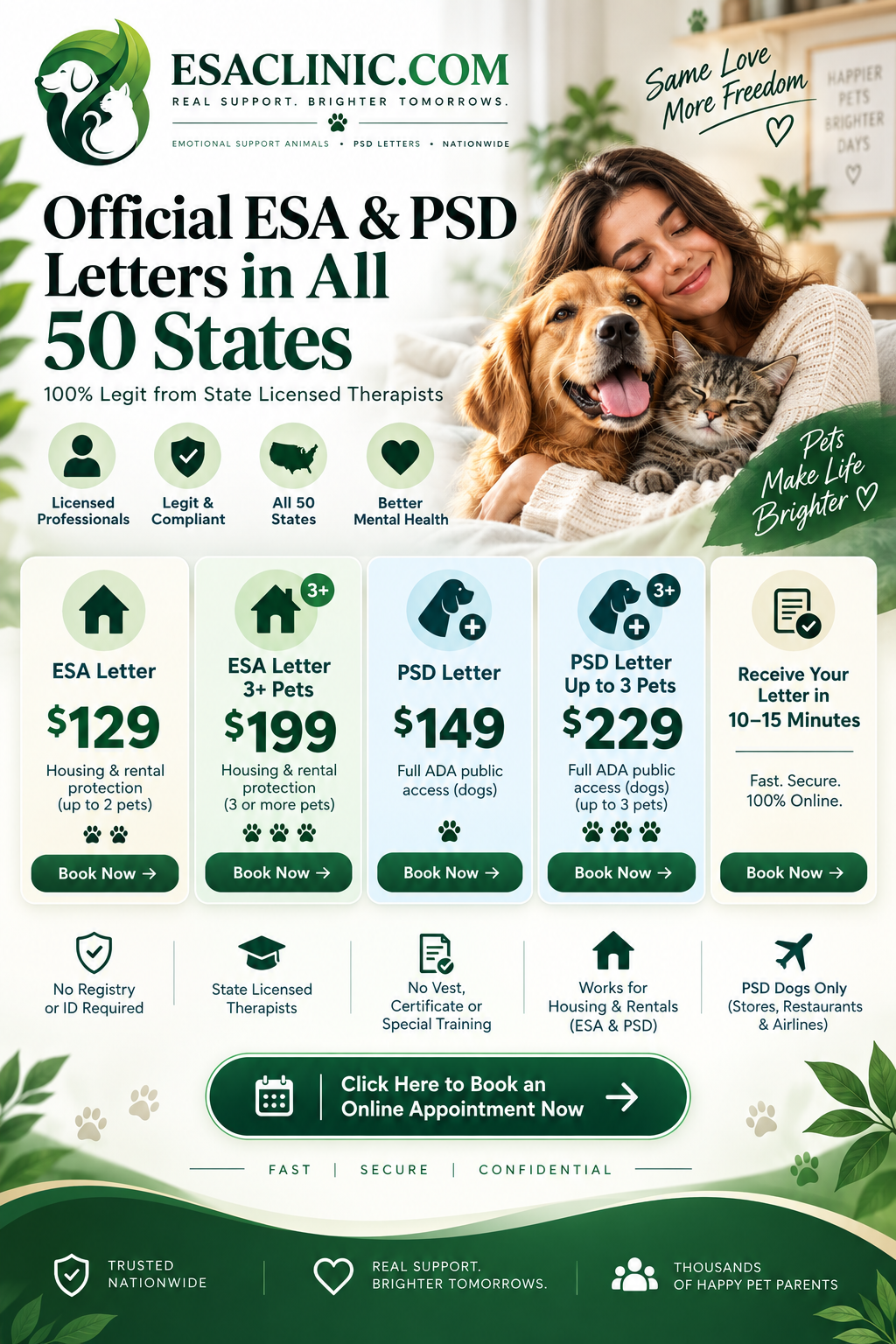

If you are looking into “registering” your dog as an ESA, there’s a vital piece of information for you right out the gate – there is no registration for ESAs anywhere in the US. There are no databases of ESA owners, no government-issued IDs for your ESA, no ESA certificates. The only thing that can legally qualify your dog as an ESA is a legitimate ESA letter issued by a qualified mental health professional.
This guide will help you understand this process and how most websites advertising their services as “ESA registration” are misleading.
Is There Really No Official ESA Registry?
Right – there is no federal mandate or registry for ESA, nor is there a database for them. Some sites offer a “registration,” which includes ID cards, certificates, and entry into a lifetime database. However, none of the above has any sort of legal recognition on its own. The landlord, employer, or airline are not compelled to recognize anything of the sort because it is not something that the law mandates.
Your ESA letter is the only legal document that you need to have – it is an officially signed recommendation by a licensed mental health professional, certifying that you have a diagnosis and your dog is providing you therapeutic benefits. That is all you need. You don’t need to do any other certification, get an ID card, or register your pet in some “official” way.
Why Do “ESA Registration” Websites Exist, Then?
This is a valid concern because knowledge of the truth will help save you money. It is worth noting that the reason why most of these websites exist is to offer products such as ID cards, vests, certificates, database inclusion, among others, which many ESA owners prefer but aren’t necessary by any means. The issue with these websites is that they sometimes blur the lines and make people believe that by “registering” their dogs, they become ESAs. This is far from the truth because only a letter from a licensed individual can make the dog an ESA.
In addition, some of these websites go even further and don’t offer a clinical evaluation but just “approve” the animal after completing an online quiz without the participation of a licensed professional. This is definitely not an ESA letter; it’s a document that a landlord can easily reject. In fact, providing such fake documents in some states may be illegal.
How to Actually Make Your Dog an ESA
Since there’s no registration process to follow, here’s what the real path looks like.
Step 1: Schedule an Evaluation With a Licensed Mental Health Professional
It is the sole step that holds any legal weight. You will have to contact someone with the right credentials to assess and diagnose any mental or emotional illnesses. This will include any of the following professionals: Licensed Psychologist, Licensed Clinical Social Worker, Licensed Professional Counselor, Psychiatrist, or in some cases, even a primary care provider that is actively treating your mental illness. This process can either be conducted in person or through a reputable telehealth program.
Step 2: Complete a Genuine Clinical Evaluation
An authentic evaluation will entail real questions that pertain to your history of mental health illness, your symptoms, and how your dog helps alleviate them. It’s not a mere formality. Again, there have been additional steps included in some states when it comes to conducting the evaluation step. Some states now require that an established relationship exists between you and the clinician, in some cases lasting 30 days or more, before the ESA letter can be issued.
Step 3: Receive Your Signed ESA Letter
If the provider determines that an ESA is the right choice for you, then they will provide you with a letter written on their letterhead. The requirements of an ESA letter include:
- The name of the provider, license number, type of license, and the licensing state
- Proof that you have the required mental/emotional disorder
- That having your dog around reduces the severity of the symptom(s) of this disorder
- The date of the letter and the signature of the provider
And you are supposed to show this letter to your landlord, HOA, or property manager, and not any ID card, certification, or registration number.
Step 4: (Optional) Adopt or Confirm Your Dog
In other words, even if you do not have a dog yet, you can complete your assessment and adopt one at a later stage if this works better for your case. There are also no requirements regarding breed, age, or size of dogs in the category of ESAs because the legal criteria are whether you have a clinical need for an ESA or not.
What About ID Cards, Vests, and Certificates?
These items are entirely optional and carry no legal weight on their own. Some ESA owners like having a vest or ID card for convenience, since it can occasionally reduce questions from curious strangers, but no landlord, business, or airline is legally required to accept them as proof of ESA status – and none of them are needed to satisfy the Fair Housing Act. If a company implies its ID card or registration is what makes your dog legally an ESA, that’s a sign to be skeptical of the rest of what they’re selling.
How ESA Clinic Approaches This Differently
These are purely optional documents which do not have any legal standing by themselves. Some people who have an ESA find it convenient to use an identification card and a vest, but there are no legal obligations for any landlord, businesses, or airlines to consider them in order to verify your ESA status. In addition, an identification card or registration cannot be considered as satisfying the requirements of the Fair Housing Act. If any business tells you that an identification card makes your pet legally an ESA, it means that you should take care of other offers of this business as well.
Do Different States Have Different Rules?
Yes, and this is something worth taking into consideration. While there is no obligation to register the documents on a federal level, there have been several states that have passed legislation in regards to issuing and contents of ESA letters. California’s AB 468 dictates that anyone issuing ESA documentation should have a valid active license in the state where the client is located, should reveal their license number and its type, and there should be an established relationship between the provider and the client, not simply a single visit. There have been other states that passed similar protective legislation to counter poor online ESA mills.
Because of the varying standards, it is worth checking whether the person evaluating you has a license in your particular state.
A Note on 2026’s Shift in Housing Enforcement
It’s also important to consider a relatively recent event that impacts how heavily you should weigh your documentation. In May 2026, HUD’s Office of Fair Housing and Equal Opportunity rescinded its ESA guidance, and the federal enforcement effort is largely geared towards trained service animals and not ESAs anymore. There has been no change to the actual language of the Fair Housing Act, but when it comes to untrained ESAs, the level of your legal protection becomes dependent on the rules in your particular state and on your documentation.
This makes the quality of your ESA letter, and especially of the organization providing it, of crucial importance. If your letter came from an organization that didn’t actually evaluate your animal, it’s much easier to challenge it these days compared to a few years back.
What Rights Does a Valid ESA Letter Actually Give You?
Having your letter in order, this is how it applies and does not apply:
Housing: By virtue of the Fair Housing Act, landlords are usually obliged to accommodate your ESA, even if they have a no-pet policy, without a pet deposit or pet rent.
Public access: Unlike service animals, which have been trained under the ADA regulations, ESAs have no right of public access. There is no need to take your dog into restaurants, retail stores, or any other establishment.
Air travel: Following a change in a 2020 DOT regulation, the airline companies are permitted to consider ESAs as regular pets, with the same charges and requirements.
Workplace: Your employer is not obliged to permit you to bring your ESA to work under any circumstances.
Common Questions About “Registering” Multiple Dogs
However, if you ask yourself whether you can have more than one dog registered as an ESA, the answer would also be logical – no specific number can be set for ESA, since there is no such registration itself. The only condition that should be met is the possibility of providing a documented necessity for the specific dog, prescribed by a licensed provider. Pet limitations in an HOA or certain building are another story; those limitations may exist even though a pet is an ESA.
Final Thoughts
If you were hoping to find out how to register your dog as an ESA, what would be most important for you to learn is the following – forget all about registration, ESA IDs, and certificates. They won’t make your dog an ESA according to the law. What really counts is the proper evaluation and the letter from a licensed mental health care provider in your state.
At ESA Clinic, we’ll help you receive your letter, which will be truly reflective of your medical necessity, not some form that you’ll be able to be questioned later on by a landlord or housing provider.
Frequently Asked Questions
Do I need to officially register my dog as an ESA?
No. There is no ESA registry in the U.S. The only document that has legal significance is the proper letter issued by a licensed mental health care provider certifying the condition and the role of your pet as your ESA.
Are ESA ID cards and certificates required?
No. They are optional and do not have any legal significance. You can choose to provide them to your landlord/business as documentation, but only a letter will be a proper legal document.
Can any dog breed become an emotional support animal?
Yes. There are no breed, age, or size restrictions for ESAs, since eligibility is based on your documented clinical need rather than your dog’s characteristics.
Does my ESA letter need to come from a provider licensed in my state?
Yes, generally. Many states, including California under AB 468, specifically require the issuing provider to hold an active license in the state where you’re located.
Can I get an ESA letter before I actually own a dog?
Yes. You can complete your evaluation first and adopt a dog afterward — you don’t need to already own the animal to start the process.
Has anything changed recently about ESA documentation requirements?
Yes. In May 2026, HUD rescinded its ESA guidance and now focuses federal enforcement on trained service animals, making strong, properly evaluated documentation more important than ever for untrained ESAs.